
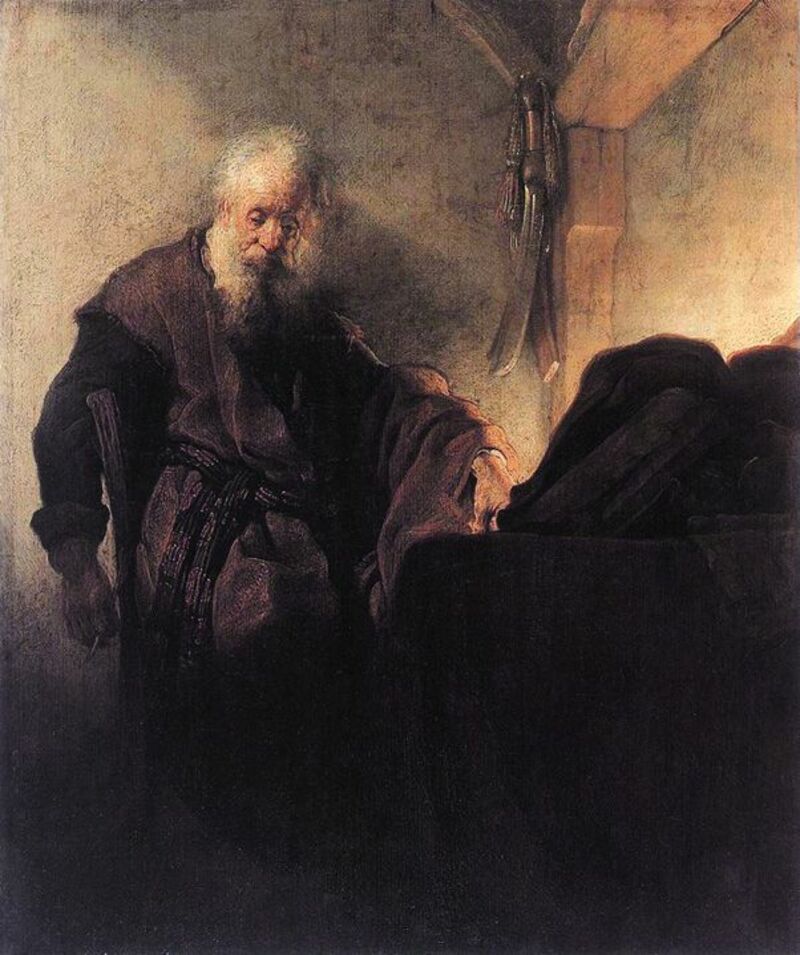
Image: Rembrandt Harmenszoon van Rijn, 1606-1669. Paul at His Writing Desk, from Art in the Christian Tradition, a project of the Vanderbilt University Divinity Library, Nashville, TN. https://act.library.vanderbilt.edu/artworks/56389 [retrieved September 6, 2026].
As many of you know, last week I was on retreat at St. Augustine’s House, an ecumenical Lutheran monastery. Begun in the late 1950s by a charismatic businessman-turned-clergyman named Arthur Carl Kreinheder, the community was an experiment in Lutheran monasticism, with an eye to ecumenical cooperation. Now, “Lutheran monasticism” sounds like a contradiction in terms, with Luther’s attacks on monasteries and his elevation of marriage. However, the experiment is still going, with two professed brothers and two associate members in residence. It is a fascinating example of deliberate community, where you can’t help but be in contact with each other, with all that entails. Love, faith, annoyance, conflict, forgiveness—all these are part of a monastic community, just as they are with any kind of in-person community.
But in the last twenty-five years, and especially since COVID, new kinds of communities have sprung up that aren’t tied to one’s geographical location. The world, in many ways, is smaller than ever. You can find a group on Facebook for just about anything, with people from all over the world. If you have an addiction concern, you can attend any number of AA or Al-Anon meetings online. And many churches have a significant online presence, with different groups depending on one’s interests. These communities have significant strengths. People can connect with asynchronous time schedules or geographic locations. This worship service, for example, will stay on Facebook for a month and on YouTube indefinitely, where anyone with an internet connection can view it.
But there are significant weaknesses to online communities.
Many traditional, in-person communities often have some barriers to entry. According to our congregation’s constitution, the church council needs to approve new members. At Shalom, we also prefer that new members be part of a new member group. To join a service club, you often need the approval of the board and pay dues. There are also impositions in a traditional community, particularly the expectation that one will show up regularly and support the community’s work. Other people in community can be hard to get along with or burdensome. And there is often a cost for public disagreement or departure; you have to put yourself out there to do so. In contrast, online communities have few or no barriers to entry, few requirements or impositions, or cost for leaving. For example, if you are offended or bored by this sermon, there is a social cost to leaving if you’re here. If you’re online, all you have to do is <<boop>>, and no one is the wiser!
It’s that burdensome, yet joyful part of Christian community I’d like to explore with you all today, especially as Paul talks about it.
Paul closes his letter to the Galatians continuing his theme of both radical freedom in Christ and radical service in the Spirit. Paul reminded the Galatians in chapter 5, “For freedom Christ has set us free. Stand firm and do not submit again to a yoke of slavery.” The Galatians are urged to not let their consciences be bound by those who would add requirements to their salvation. But he also reminded them “Live by the Spirit and do not gratify the desires of the flesh.” He then went on to elaborate what the fruits of such Spirit-guided living are: love, joy, peace, patience, kindness, generosity, faithfulness, gentleness, and self-control. Such fruit doesn’t come from compulsion or threats, but only out of the freedom we have in Christ.
And yet, as Lutheran theologian Dietrich Bonhoeffer once observed, it is that very freedom of another person that can make us so burdensome to each other. Christian community is not a group of Stepford wives, as anyone who has been a part of a church for more than ten seconds knows! (For the kids out there, the Stepford Wives is a novel from the 70s where women are replaced by obedient robot replicas.) Bonhoeffer elaborates:
All that we mean by human nature, individuality, and talent is part of the other person’s freedom—as are the other’s weaknesses and peculiarities that so sorely try our patience, and everything that produces the plethora of clashes, differences, and arguments between me and the other. Here, bearing the burden of the other means tolerating the reality of the other’s creation by God—affirming it, and in bearing with it, breaking through to delight in it.[1]
This breaking through, of course, only comes by the grace of God in Jesus Christ. Because Jesus Christ not only descended to our world to deliver us from our sins, he also formed a community of deeply-flawed men and women to continue his work around that forgiveness. Peter is such a wonderful example. The gentle way that Jesus restores Peter to community in our reading from John’s Gospel shows how Jesus deals with sinners like us; it is the spirit of gentleness that Paul writes of. Jesus doesn’t shame Peter; he doesn’t coerce him. It certainly hurts to be asked three times if he really loves Jesus. But Peter is restored to community and is given the same command he was given in John chapter 2: Follow Jesus. Jesus bears with Peter, and brings him back in a way that creates lasting joy.
Like Peter, Jesus calls us back to himself, calling us to shore to enjoy a meal he has prepared. Jesus calls to us to live in a community that is radically unlike any other community. Every other community is based, ultimately, on transaction. You do this, I do that. That isn’t necessarily bad; it’s just the way of the world. But Jesus’ community is different. We didn’t do anything at first to be part of it. Jesus chose us and gave us one command: love one another as he has loved us. He turns transactional community on its head. We aren’t to love our neighbors, forgive their sins, put up with their idiosyncrasies and weaknesses to receive the love of God in Christ. No, we are invited to do those things because Jesus’ love has set us free. In communion, we receive that very love—the love that forgives, the love that restores, the love that frees. So receive Jesus again today. Be forgiven. And be loved, beloved people of God. Through the burden of one another, God help us to find the joy of his new community. Amen.
© 2026, David M. Fleener. Permission granted to copy and adapt original material herein for non-commercial purposes.
[1] Bonhoeffer, Life Together, (Minneapolis: Fortress Press), p. 101
