
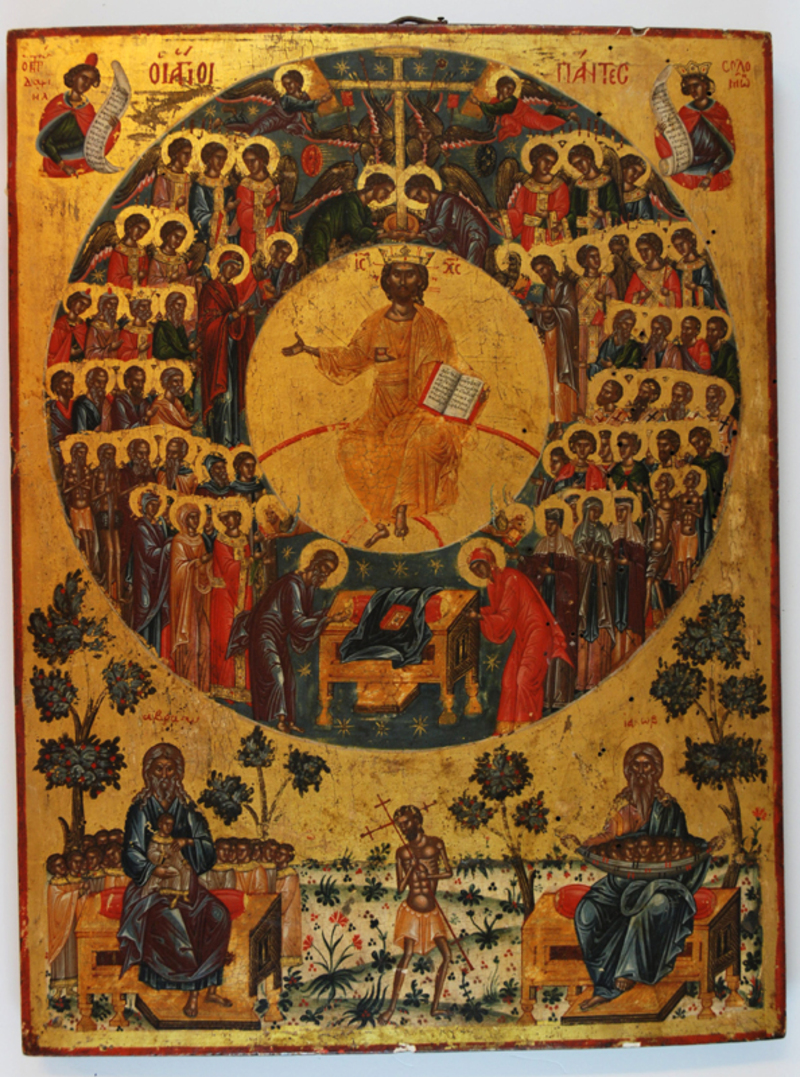
Image: Icon of All Saints, https://iconreader.wordpress.com/2013/07/01/all-saints-icon-the-great-cloud-of-witnesses/. Retrieved August 16, 2026.
As we continue in Galatians, Paul moves into the heart of his letter. We have already heard about his unique call—not from ordinary human authorities, but from Jesus himself. We have also heard about his relationship with the other apostles, especially Peter and James, the brother of Jesus and leader of the Jerusalem church. And we know that Paul was sent to bring the gospel to gentile regions.
But other teachers had arrived in Galatia with a different message. They insisted that Torah observance, in addition to faith in Christ, was necessary for true unity among God’s people.
On this side of heaven, we know that unity is complicated. United people can accomplish great things. The civil rights movements of the 1950s, 60s, and 70s, for example, were shaped by a shared commitment to the ideals of the Declaration of Independence: that “all men are created equal, that they are endowed by their Creator with certain unalienable rights, that among these are life, liberty, and the pursuit of happiness.” Those movements helped lead to greater equality among Americans.
But unity can also be turned toward great harm. Few examples are more devastating than the willing submission of much of the German population under the swastika between 1933 and 1945 in the name of national pride.
Earthly unity, then, is not automatically good. It can be mobilized for healing or destruction, justice or oppression. The desire for unity often carries mixed motives. One person’s unity may look like assimilation, exclusion, or control to someone else.
Things were not so different in the ancient world. Whoever these teachers in Galatia were, they likely believed Paul was asking too little of gentile converts. They may have thought he was watering down the rigor required for a faithful life.
After all, how could Christ alone be enough when God had given so many commandments in the written Word? There are 613 laws in the Torah. Paul himself says in this reading that the law is “not opposed to the promises of God.” In Romans, he will go even further, calling the law “holy, just, and good.”
The most charitable reading is that these teachers cared deeply about proper obedience to what God commands.
But Paul isn't having it. He accuses these teachers of placing obstacles in the way of the gentiles’ faith in Jesus. In their zeal for the letter of the Word, Paul would say, they have ignored the Spirit who gave breath to that Word in the first place.
To make his point, Paul goes back before the giving of the law at Sinai—even before the command of circumcision given to Abraham. He returns to the beginning of God’s relationship with Abraham. In Genesis 12:3, God says, “In you all the families of the earth will be blessed.” Paul’s quotation is essentially the same: “All the gentiles shall be blessed in you.” The whole human family is blessed, Paul says, through Abraham’s faith in God—but even more deeply, through God’s faithfulness to Abraham.
That promise took a long time to come to fruition. God first made the promise to Abraham when Abraham was seventy-five years old. Nearly twenty-five years passed before Isaac was born.
During those years, Abraham and Sarah waited, stumbled, doubted, and acted unfaithfully more than once. Abraham twice endangered Sarah by claiming she was his sister rather than his wife. Sarah tried to force the promise by giving Hagar, her enslaved servant, to Abraham. Abraham went along with it. Both Abraham and Sarah laughed bitterly when God repeated the promise in Genesis 17 and 18.
They were real people with real failures. The only thing constant in their story is the faithfulness of God. Even Abraham’s faith is a gift from God.
Yet, the promise to Abraham had far greater effects than Abraham could have imagined. Jesus the Messiah is the ultimate fulfillment of that ancient promise. In Christ, everyone is welcome—whoever they are and wherever they come from. The church, admittedly, does not always reflect this truth well. But in Christ, everyone is welcome. God does not make junk. In Jesus, the old foundations for unity are relativized. Nationality, language, race, religious background, gender, sexuality, politics, and every other dividing line can no longer define who belongs to God. For Paul, this means that being Jew or Greek, slave or free, male or female has no ultimate importance. A new creation has come in Jesus Christ.
This new creation relativizes all those identities. There can be no other final basis for unity in the church than Jesus Christ and the freedom he gives us from treating old dividing lines as permanent.
Some boundaries may still be necessary for security and order in a fallen world. This is part of what Paul calls the “disciplinarian” function of the law. The new creation in Christ is an already-but-not-yet reality: it is already present among us, but it is not yet fully realized.
Even so, the old dividing lines do not get the final word. They are not the final judge of who is worthy of God’s promises. Faith has come as a pure gift of God, opening our eyes to see ourselves—and all who belong to Christ—as part of a new creation.
That new creation began in us in a humble way. Water was poured over our heads at the baptismal font, and prayers were spoken. Parents held us. The congregation oohed and aahed, promising to support the newly baptized. Yet in that simple moment, something of life-and-death importance was happening. The old creature—the one that loves and defends old divisions as ultimate—was mortally wounded. And a new person was born in us. That new person was united to the rest of Christ’s body, not by the earthly markers of race, class, gender, nationality, or any other human distinction, but by Jesus Christ alone.
Jesus is the fullness of the new person. He is the image of humanity into which we have been born. This does not mean we lose who we are. It means we are being made into Christ’s image in our own particular and unique ways. That is the new, heavenly unity we have—the unity which surpasses all earthly unities. Christ alone is our unity. Nothing else. No one else.
So how do we live now? We live knowing that the old divisions do not have the final word. We live out the unique callings God has given us, trusting that God is faithful and will bring to fulfillment the promises we have in Christ. And we have those promises not because of who we are or what we do, but because of what Christ has called us to be: a new creation in him. Amen.
© 2026, David M. Fleener. Permission granted to copy and adapt original material herein for non-commercial purposes.
