
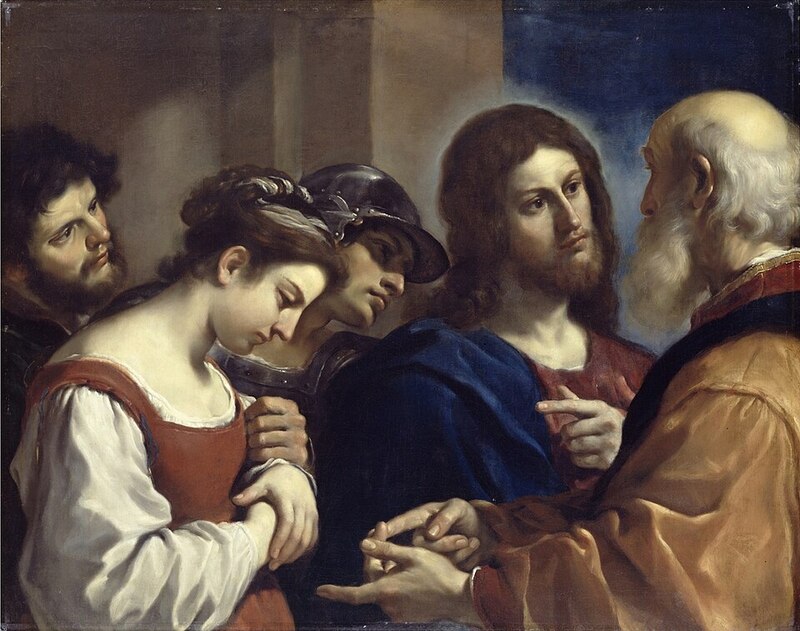
Image: Christ with the Woman Taken in Adultery, by Guercino, 1621
July 5, 2026: Pentecost 6, Ten Commandments 4
Exodus 20:13-15
Actions Matter
In the movie Groundhog Day, Bill Murray’s character Phil finds himself caught in a time loop, living the same day over and over again. In one scene, he tells his tale of woe at a bar with two locals, Gus and Ralph, asking “What would you do if you were stuck in one place and every day was exactly the same, and nothing that you did mattered?” While Gus downs a shot and grimaces, a drunken Ralph says, “That about sums it up for me.”
Often, we are tempted to feel the same way as Ralph. Life can feel like one damn thing after another. We may feel unable to affect the course of our lives or the world around us. Habits and addictions can feed into that. And then there’s the powerlessness many of us feel about our nation.
This weekend, we celebrate the 250th anniversary of our nation’s founding. And I highly doubt that the Founding Fathers could have anticipated how successful their experiment would be or the size of government today relative to the individual citizen. Many Americans these days feel so powerless to change things that, in a poll conduct by NPR, PBS, and Marist, 37% of their sample size believed that violence may be necessary to get the country back on track, up 19% from a year-and-a-half ago.[1] Our country has faced extreme challenges before but that’s an alarming number. The resort to violence is a desperate attempt to claw back not just power, but meaning. Along with powerlessness comes meaninglessness. Nihilism.
But a long time ago, God gave his people commandments, not to enslave them by petty rules, but to help them live as a free people. And one of the main things these commandments teach us is that our actions matter, contrary to the feelings of poor, drunken Ralph.
We’re into what is called the second table of the commandments now. Commandments One through Three concerned our relationship with God. The last six concern our relationship with our neighbors. And the Fourth—“Honor your father and mother”—is a bridge between the two. Mothers and fathers are human, but their authority and office come from God. Most of us have our first experience of God through our parents, for good and for ill.
And today, Commandments Five through Seven remind us just how much our actions can affect ourselves and our neighbors. Most of us haven’t killed anybody. But all of us certainly have done harmful things to ourselves and to others. And it begins with how we think or talk about them. Who here has an “inner critic”, where you criticize and berate yourself? I do, to the point where when Sarah overhears me, she’ll say, “Stop talking about my husband that way!” That’s breaking the Fifth Commandment. So is our negative talk about others. Even if we aren’t physically harming them, we are damaging them. Luther tells us bluntly, “The meaning of this commandment, then, is that no one should harm another person for any evil deed, no matter how much that person deserves it.”[2] He takes it further, saying we break this commandment “when we have the opportunity to do good to our neighbors and to prevent, protect, and save them from suffering bodily harm or injury, but fail to do so.”[3] More on this when Pastor Dennis preaches next Sunday.
The same is true for the Sixth and Seventh Commandments. Our actions, however small they seem to us, matter, and affect our neighbors and ourselves. In Matthew’s Gospel, Jesus warns of the ripple effects by even wanting to sleep with someone who isn’t our spouse. It can affect not just our own relationship with our spouse but our relationship with others by reducing people to mere objects for self-gratification. But it isn’t just desire. Even the way marriage is portrayed or talked about can dishonor it. There’s “the old ball-and-chain”. My friends and I knew a guy who called his girlfriend, who was a classmate of ours “the wife”. After they got married, he called her “the old lady”. These are jokes of course, but jokes can have consequences. How many sitcoms are there where the husband is a fat, dumb lout, the wife is a shrew, and the children are terrible?
With the Seventh Commandment, even if we haven’t shoplifted, we certainly have taken things that don’t belong to us. In the Large Catechism, Luther talks about theft in the marketplace under the guise of legality: “…stealing is not just robbing someone’s safe or pocketbook but also taking advantage of someone in the market, in all stores, butcher shops, wine and beer cellars, workshops, and, in short, wherever business is transacted and money is exchanged for goods or services.”[4] This absolutely applies to our investments, too. How many of us are invested in companies we know have questionable business practices but the return is good? Little wonder Luther calls thievery “the most common craft and the largest guild on earth.”[5] No sin is ever truly a private sin. There are ripple effects to everything we do. And the consequences can be disastrous.
But there is good news. And that is that even though our actions matter, God’s actions matter far more. And though God does judge us, God’s mercy ultimately has the last word. God offers us forgiveness, whoever we are or whatever we’ve done. That applies also to people we think deserve only judgment. If I were to ask you today who you think deserves no mercy, each of you might come up with at least a few names. That is the offense of the incarnation and the cross. For undeserving people like us, hellbent on going our own way, God descends to us in the man Jesus. And he took on himself all our failures. All our disasters. The sin of the whole world. As Paul wrote the church in Corinth, “He was made to be sin who knew no sin, so that in him we might become the righteousness of God.”[6] That is made especially plain to us in his suffering on the cross. And we know that sin is far more than what we do or fail to do. It is our whole desperate situation we were born into, which has turned this good world into what theologian Paul Griffiths calls “the devastation”. God in Christ acts when we could not to free this world from its addiction to going its own way, that is, to sin. God in Christ acts when we could not to give us mercy and forgiveness. But more than that. In baptism, God makes us members of his family. At that font, God begins to work on us from the inside out to form the image of Christ within us. And every time we gather after a long week, where we have accumulated indignities, injustices, and sins, we hear the Word again. We receive Christ’s body and blood again. And we are forgiven and renewed for life in this world, until God brings the fullness of his reign to us. In other words, when we were rendered powerless by sin, God gives us power to live a new life.
What we do matters. We are not powerless in this world, though we may be tempted to believe that. But what God does matters infinitely more. In times of hopelessness, despair, and powerlessness, God keep us faithful to that good news that we are freed in Christ. And God free our actions for building up his reign among us now. Thanks be to God. Amen.
© 2026, David M. Fleener. Permission granted to copy and adapt original material herein for non-commercial purposes.
[1] https://maristpoll.marist.edu/polls/america-250-july-2026/. Retrieved July 4, 2026.
[2] Robert Kolb, Timothy J. Wengert, and Charles P. Arand, The Book of Concord: The Confessions of the Evangelical Lutheran Church (Minneapolis, MN: Fortress Press, 2000), 411.
[3] Ibid., 412.
[4] Ibid., 416.
[5] Ibid, 417.
[6] 2 Corinthians 5:21.