
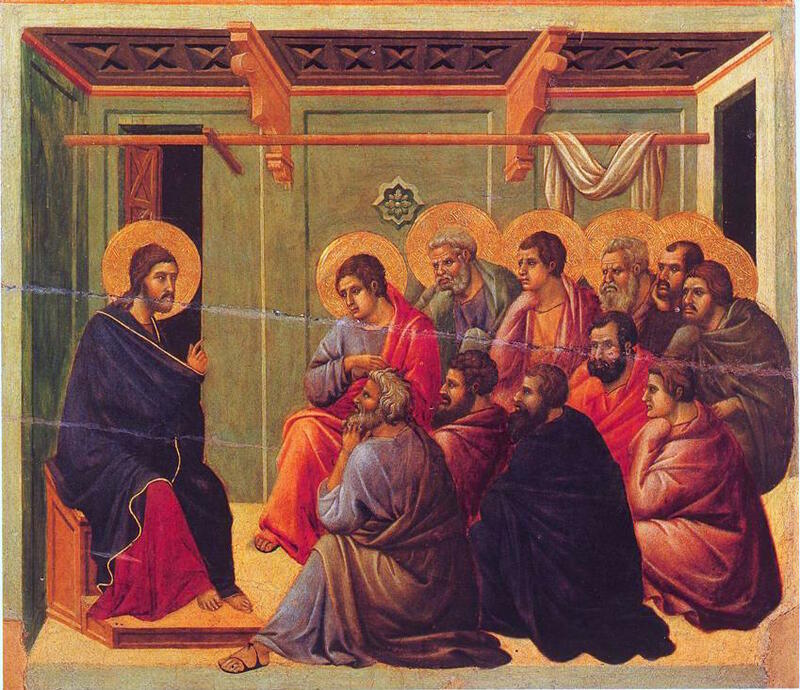
Image: An image of Christ and the apostles from Maestà by Duccio, 1308-1311
Today, we hear Jesus pray for his community of disciples, both those who walked the earth with him, and those who would be disciples in the future. There are a lot of striking and paradoxical things about this prayer. Jesus prays for the Father to glorify him, which we know is wildly different from the world’s kind of glory. It’s a glory known through his suffering and death. He also notes that his Father has given him authority over all people, which also wouldn’t be apparent to the outside world. The seat of Jesus’ power; the location of his enthronement is also on the cross. But what strikes me the most today is Jesus’ prayer for unity among his disciples, that “they may all be one as we (Father and Son) are one.”
It’s a beautiful prayer. And it’s probably the one we approach with the least amount of trust in God’s ability to accomplish it! Whenever we come to a new community, whether a marriage or a congregation or a city, we usually have definite ideas of what that unity ought to look like. Most of us expect community members to be nice to each other! Nothing wrong with that. It’s kind of a bare minimum. But we have other expectations, too. We often expect widespread agreement on most issues, from cultural to theological to political. And most problematically, many people also expect an absence of conflict, or failing that, at least an absence of conflict that leaves hard feelings. And when this third expectation fails, as it does in every single community that has ever existed, it can really mess us up.
Case in point. Once upon a time, a young couple got married. A month later, the bride was back at her parent’s house in tears. “I don’t know if I can stay married to him!” she cried. Perplexed, her mother asked, “Why? Did he do something to you? Is he abusive or having an affair?” “No,” she said. “Then what’s the problem?” her mother asked. “We had a fight,” she sobbed. “I never saw you and Dad ever fight! That must mean things have really gone wrong!” “No, sweetie,” her mother said. “Your Dad and I argued all the time! We just didn’t do it around you.” The bride’s picture of marital unity was utterly unrealistic, distorted by her childhood experiences.
Christian community is also no stranger to dangerous, unrealistic expectations such as those of that bride. It’s easy to forget that Christian community is made up of flesh-and-blood people who are just as sinful as we are, who are as people in as much need of grace and forgiveness as we are! And church fights, at least on the surface, are rarely about issues central to faith or mission. They are usually kicked off by other concerns, such as “What color will we paint the walls?” or “Where should we hang this picture?”. They are also often about personality conflicts. That doesn’t mean that these concerns are unimportant. They have their place. They need to be discussed. But usually something else is going on. Disappointment, feeling powerless, unresolved anger, unforgiveness, or lack of trust are usually lingering behind these conflicts. And if these feelings aren’t addressed, they can cause a lot of harm. Theologian and pastor Dietrich Bonhoeffer gives us a stark warning in his book Life Together: “Those who love their dream of a Christian community more than the Christian community itself become destroyers of that Christian community even though their personal intentions may be ever so honest, earnest, and sacrificial.”[1] When we love our expectations of community more than the people in it, we can have the false belief that unity is something we have to accomplish by our own power.
And when that disillusionment comes, we can receive it not as condemnation or failure, but as an act of radical grace. Disappointment can be one of the best gifts we ever receive from God. When our vision for community is shattered, God’s vision can take root. And in God’s vision, unity isn’t our job. Yes, you heard that right. Christian unity is not a task for us to accomplish. It isn’t something to get people on board with, either by carrot or stick. It isn’t to be driven by a few dominant personalities. It isn’t to be engineered by the pastor, staff, or Council. It isn’t accomplished through congregational offerings, programming, or music. If it were, all Christian communities would have been swallowed up long ago by petty power concerns or grievances. Rather, unity is found only in Jesus Christ, who was raised up on the cross to draw all people to himself. Our unity is found only in him who reveals our sin to us and forgives us that sin in Word and Sacrament. Unity is God’s work, not ours. It is done in God’s good time, according to God’s radical grace in Christ Jesus. We can’t make it happen on our own. Indeed, God’s Work is often done despite our attempts to hinder it! Rather, we receive our unity in Christ as a gift. Jesus is our radical equalizer. Before him, we are all guilty of sin, deeply wounded by sin, and in need of forgiveness. Every last one of us.
So, (and this is to you, too, Caedyn), whenever we are part of Christian community, and especially when we come to Holy Communion, we are admitting three things.
First, we’re confessing that we’re children of God, made in God’s image and redeemed in Christ’s image. Second, we’re confessing that we’re flawed. That we fail. If you’re not a sinner, you can’t be part of Christian community! After all, Jesus says that he comes to call sinners, not the righteous. Third, when we are part of Christian community, we are here primarily to receive forgiveness and to be empowered to forgive in return. We’re confessing that our unity is found only in the forgiveness we have in Jesus Christ.
Caedyn, as you take your baptismal vows as your own, remember that you are such a child of God. Remember that you’re a sinner. Remember that forgiveness is here whenever the Word is proclaimed and the Sacraments are received, and that you are also empowered here to forgive others as Jesus has forgiven you. And remember most of all that unified community is not something we impose, but something that God accomplishes. Jesus’ gift of unity may not look the way we expect. But it is one of the most powerful gifts we can receive. Amen.
[1] Dietrich Bonhoeffer. Life Together and Prayerbook of the Bible (Dietrich Bonhoeffer Works 10) (p. 36). Fortress Press. Kindle Edition.