
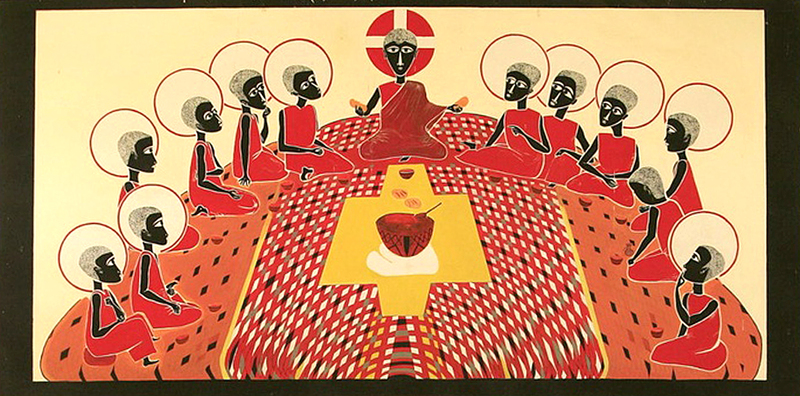
Image: Father George Saget, Last Supper, from Art in the Christian Tradition, a project of the Vanderbilt Divinity Library, Nashville, TN. https://diglib.library.vanderbilt.edu/act-imagelink.pl?RC=58346 [retrieved April 2, 2026]. Original source: Robert Harding Photographers, https://www.robertharding.com/.
Give me that old time religion, (repeat 2x)
It’s good enough for me.
It was good for the Hebrew children. (repeat 2x)
And it’s good enough for me.
I am being a little tongue-in-cheek. Most of us probably wouldn’t care much for the form “that old time religion” took back in Moses’s day. The elaborate preparations in making the altar, the exorbitant expense and work in sacrificing all those animals and collecting their blood is utterly foreign to how we practice our faith. And on top of that, Moses sprinkles the blood all over the altar and people. It’s not nice, neat, or clean. It’s not sanitary. It seems barbaric, an embarrassing relic of our faith history that ought to remain there.
But if we simply judge the story as a barbaric relic, we miss the depth of what is happening both there and at our Lord’s Supper. These covenants—which in the end, are really one covenant—reveal a God who is utterly faithful in a faithless world.
Back in Exodus, this covenant sealing ceremony occurs after God gives the Commandments directly to the people, plus another three chapters of God’s instruction through Moses. Shedding blood shows this covenant is to be taken seriously. It is costly. It is inconvenient. It is imposing. God promises to be their God, and the people promise to be God’s people.
However, things went wrong. Only a few short chapters later, wracked with anxiety over Moses’s extended absence, the people enlist Moses’s brother Aaron to make a golden calf for them. How quickly they acted unfaithfully: to God, to Moses, and to their neighbors.
Yet, God remained faithful. Over the next forty years, God led them, despite their ongoing infidelity, into the Promised Land, God kept his promise, just as God always does.
The same happens in our reading from Matthew. The Lord’s Supper is set in the middle of a story of betrayal and abandonment. Judas will hand Jesus over to his death. Peter will deny him. The rest of the disciples will abandon him. And in a profound mystery, even Jesus’s Abba Father will leave him as he hangs on the cross. Jesus is left utterly alone. The one who knows no sin becomes sin for our sake. To all outward appearances, he is just another crucified rebel.
And we know, if we’re honest, that we’re no better than our ancestors in faith. We are just as sinful as they were. And sin, as we know, is not just the individual acts we do wrong. It isn’t just the way we hurt ourselves or our neighbors. Sin is the whole desperate human condition. It is the captivity that keeps us estranged from God, creation, and our neighbors. It is our disposition toward unfaithfulness rather than faithfulness. How quickly our fear, anxiety, wrath, greed, and envy drive us to betray our baptismal promises.
But Jesus does not write us off. Jesus does not abandon us to our own devices. Rather, Jesus is our great reconciler to God, creation, and our neighbors. Though Jesus was abandoned, he remained faithful. He remained faithful to the task his Father set before him before he was born, which the angel speaks in Matthew 1:21: “He will save his people from their sins.” He was faithful to his disciples. And he remains faithful in a most important way to us. In, with, and under a humble meal of bread and wine, he remains ever-present with us. He gives us new life. He forgives our sin.
In the middle of the devasting mess we have made, Jesus gives us himself. But not just a little bit of himself. Jesus doesn’t just give himself in a non-material, higher, so-called “spiritual” way. Jesus gives himself to us completely in this meal, body and soul. At this table, Jesus is utterly vulnerable, just as he was completely vulnerable on the cross. And in this complete vulnerability, he shows us what true power really looks like. True power is the power to lay down his life for us. True power is the power to reconcile us to God and each other. True power is the power to heal what is broken and forgive sins. And true power is finally the power to love that which only God can love. Jesus does all that here at this table and many others like it.
Which brings me to another Maundy Thursday rite: the individual forgiveness of sins. What gives me, your pastor, the right to lay my hands on your heads and say, “I forgive you all your sins,”? Only the command and promise of Jesus. There is obviously nothing in my own self or capacity that can forgive your sins. I’m a sinner too, after all. I often ask my wife to speak those words of forgiveness to me at this service because she has the most to forgive. What happens there is what happens at this table or what happens at baptism. Jesus, using my voice, speaks those words of forgiveness to you. He speaks those words of forgiveness so that you can have faith that you are truly forgiven. It is out of his faithfulness that he speaks those words. It is out of his faithfulness that he gives us his body and blood to forgive our sins. And being forgiven, we are strengthened for lives of mutual forgiveness. When we forgive someone, it is Jesus forgiving them through us.
And that truly is the old-time religion we cling to. We cling to the forgiveness, love, and mercy we receive from Jesus and his faithfulness to us in every aspect of our lives. God help us all to come from this service strengthened by that good news to forgive our neighbors also, and to live faithfully to them, to creation, and to God. Amen.
© 2026, David M. Fleener. Permission granted to copy and adapt original material herein for non-commercial purposes.