
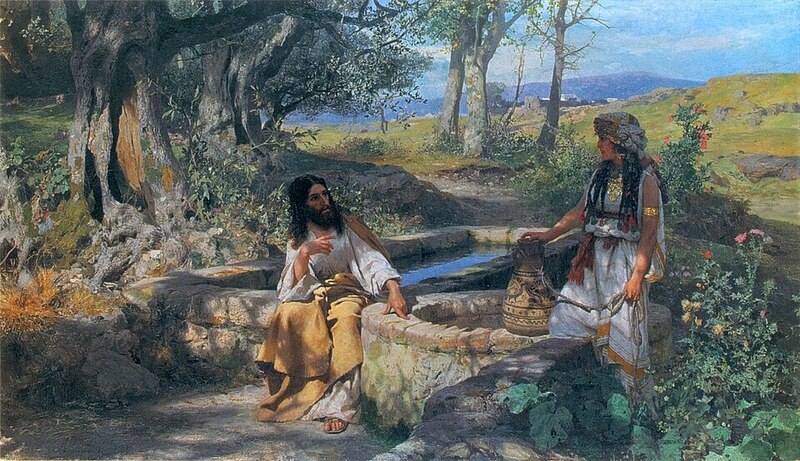
Image: Christ and Samaritan by Henryk Siemiradzki (c. 1890)
Last week, we overheard Jesus’s nighttime conversation with Nicodemus, a Jewish high official. Nicodemus was totally flummoxed. Even though he “should” understand Jesus, being a learned man, well-acquainted with the law and prophets, he does not. This week is different. Jesus has a noontime encounter with a Samaritan woman by Jacob’s well. And she is the opposite of Nicodemus in pretty much every way. She’s a woman. She’s a Samaritan, an enemy of the Jews. She has neither formal status nor education. And there are some curiosities in her personal life that Nicodemus doesn’t seem to have. (I say “curiosities” rather than moral failings because there are any number of reasons a woman of patriarchal 1st century Palestine would have had five husbands.)
But these aren’t terribly important compared to the main difference. And that is that this woman has faith. Nicodemus seems frightened, but the woman is unafraid of both Jesus and the people of her town. Nicodemus does not understand who Jesus is, but she understands who he is and what he has come to do. And while Nicodemus is stuck in a literal understanding of being “born from above”, she grows from a literal understanding of “living water” to its full meaning: the gospel of eternal life in Jesus Christ.
You see, our faith or unfaith directs our lives, for good or for ill. In the fifth century, St. Augustine said that pride is the chief sin from which all other sins spring. But the root of pride is unfaith and bad faith. Pride is believing oneself to be God or believing a proxy (a leader, the nation, the family, even the church) is God. Pride is the soul’s turn inward upon itself, seeing itself as the source and norm of existence. And two things often happen as a result of pride: we either fall into despair when our idols crumble, or we continue to exhaust ourselves and others in trying to take control. We find it very difficult to “fear, love, and trust God above all things”, as Luther’s explanation to the First Commandment says.
This is why I love the stories of the Old Testament. The failures of the Israelites mirror our failures, particularly their failure to have faith in the God who saved them. And like us, when they lacked faith, they often tried to take matters into their own hands. In the version of our Old Testament story told in Numbers, Moses is so upset with the people that he fails to follow God’s instructions to command the rock to give water. Instead, he growls, “Listen, you rebels, shall we get water for you out of this rock?” and strikes it twice. This show frustration, a desire for control, and a lack of trust in God. The people, for their part, are often forming “back to Egypt” committees when things get hard, dreaming about how much better life was when they were enslaved. All this after God shows his mercy time and time again! There’s the rescue at the Sea from Egypt. The manna from heaven. The deliverance from the Amalekites. The guiding pillars of cloud and fire. Despite these mercies, the people have great difficulty trusting God.
And when they get like that, they turn in on themselves. Their hunger and thirst reduce the world to itself, like it would for us. In anxious times, we face similar temptations, like “We need to take care of our own first.” Or, “We need to look out for ourselves.” Or, “We can only rely on ourselves.” Such temptations can become castle walls that, under the appearance of protecting ourselves, prevent genuine engagement in and love of our community and world.
But Jesus breaks down those walls, beginning with his own life and ministry. Jesus Christ, the Son and Word of God, does not stay safely ensconced in heaven. He does not “look out for number 1”. Jesus, rather, makes his home with us. In him, God descends to our world to draw all people to himself under the shadow of the cross. And having broken the boundaries of heaven and earth, he also breaks the boundaries we set up in this world, especially the boundaries of unfaith.
Notice what happens. We’re told that Jesus “has to” go through Samaria that day. That’s a clue that what is happening here is by the will of God. He must be beside Jacob’s well. And that lone Samaritan woman must be there at a strange hour to draw water (usually water would be drawn at dawn or dusk). Everything is unfolding according to God’s will, including Jesus’s outrageous breach of decorum by asking her for a drink.
She’s surprised, if not shocked by this. After all, the feud between Jews and Samaritans had roots in the split between the northern tribes and Judah in the 10th century BC. Things had accelerated after the return of the exiles in the 6th century BC. There’s a lot of bad blood there. But the conversation continues. And she realizes she’s talking to no ordinary Jewish man. She’s talking to the Chosen One of God, who has a universal vision of human flourishing, where all peoples worship the Father in Spirit and truth. She is transformed into an apostle who is sent to give Jesus’s living water of the gospel to others.
But it isn’t just her who needs transformation! The disciples come back from their trip to town and are shocked by what they see! John’s Gospel tells us that no one dares to question Jesus, but we’re given a window into their thoughts. “Why are you speaking with her? What do you want from her? It’s bad enough that you’re talking to a woman alone. But she’s a Samaritan, too! She’s not one of us! Shouldn’t we focus on our own, Jesus? Wouldn’t that be the wiser course of action?”
But the living water of Jesus is not just for one group of people. It is for everyone: Jews, Samaritans, Arabs, Norwegians, Swedes, Germans, Iranians, Americans, Lutherans, Methodists, Catholics, straight, gay, cis, trans, poor, rich, white, Black, Latino, Chinese. The saving gospel of Jesus is for everyone. And it is for you. Jesus invites everyone to partake in that living water that flows from him and unites us as one. It isn’t ours to control. It is simply ours to share.
And our own mission statement as Shalom Church echoes that invitation: “We believe God is calling us to invite people to have a deeper relationship with Christ….” We are called, like the Samaritan woman, to both receive Jesus and give people Jesus. Having received him, we invite others to an encounter with the living Lord in Word, Sacrament, and service. Jesus is here…and he is out there. He is not our exclusive property. We don’t have to fearfully huddle, waiting for a more opportune time to be people of the gospel. Jesus corrects his disciples: “You say, ‘I have four months until the harvest.’ But the time is now.” The time is now, friends, to trust the Lord. To believe him when he says he is present at this table for you, to forgive your sins. To let go of our pride and unfaith. To cling to him and his promises even when we struggle to trust him. We invite because we know that in Jesus, and Jesus alone, we have life. Amen.
© 2026, David M. Fleener. Permission granted to copy and adapt original material herein for non-commercial purposes.